Introduction
AI agents—autonomous or semi-autonomous systems powered by machine learning and natural language processing—are increasingly integrated into critical applications. Their ability to make decisions and interact dynamically introduces novel security challenges beyond traditional software vulnerabilities. Evaluating their security requires specialized approaches that consider both AI-specific risks and conventional cybersecurity threats.
Key Security Evaluation Considerations for AI Agents
1. Understand the AI Agent's Operational Context
Security evaluation must begin with a clear understanding of the AI agent’s deployment environment, data sources, and interaction modes. For example, an AI agent embedded in a financial trading platform faces different threats than a customer service chatbot. This context shapes threat modeling and risk prioritization.
2. Threat Modeling Tailored to AI Agents
Traditional threat modeling techniques can be adapted to AI agents by incorporating AI-specific attack vectors such as:
- Adversarial inputs: Inputs crafted to manipulate AI behavior.
- Data poisoning: Corrupting training or update data to degrade performance or induce malicious behavior.
- Model extraction and inversion: Attempts to steal or infer sensitive model parameters or training data.
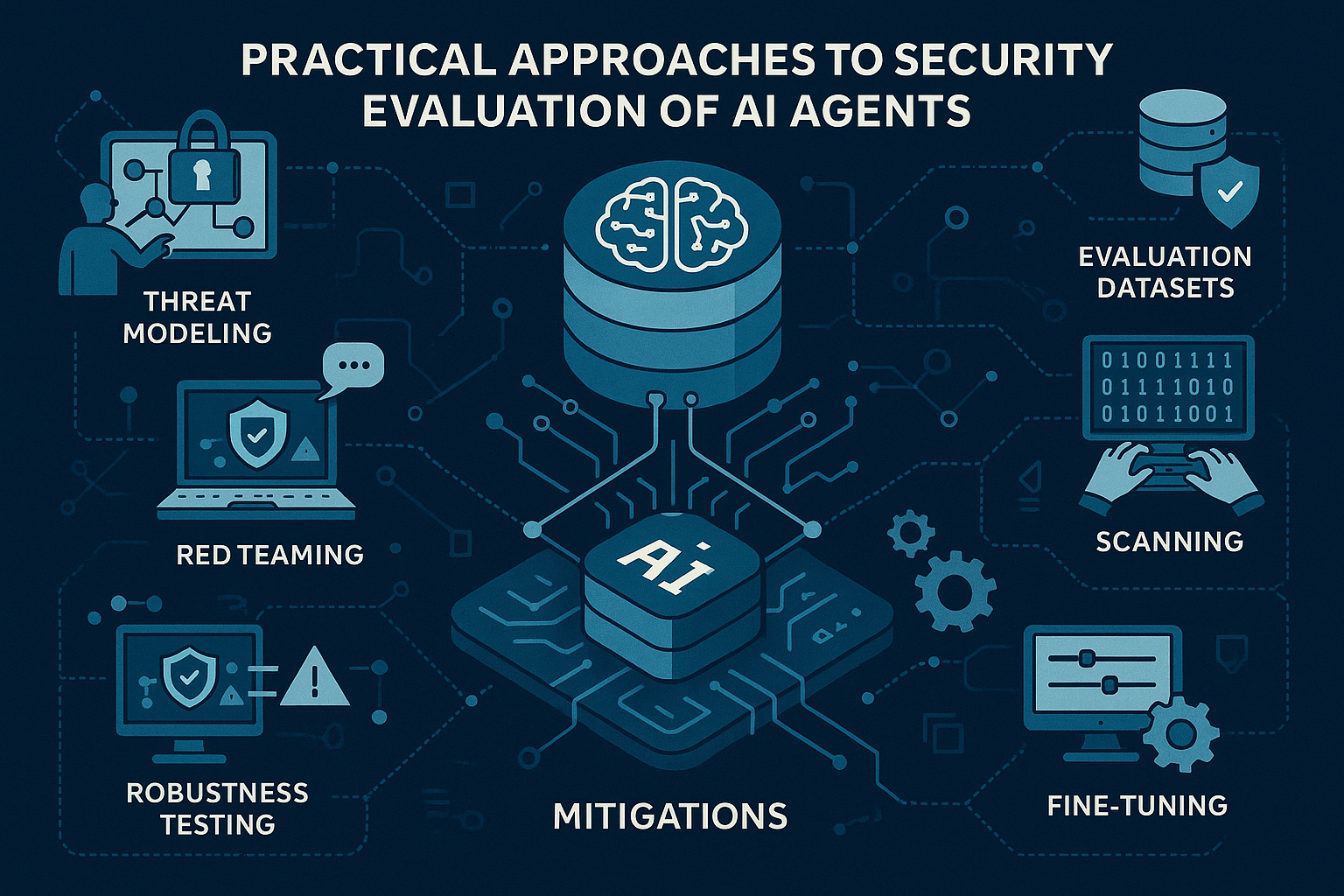
Threat modeling should map these AI-specific threats alongside conventional risks like unauthorized access or denial of service.
3. Use Established AI Risk Management Frameworks
Frameworks like the NIST AI Risk Management Framework provide structured guidance for identifying, assessing, and mitigating AI risks, including security. They emphasize iterative evaluation throughout the AI lifecycle—from design and development to deployment and monitoring.
4. Adversarial Testing and Red Team Exercises
Security evaluation should include adversarial testing where simulated attacks probe the AI agent’s resilience. For instance, feeding adversarial examples to image recognition agents or injecting malicious prompts into language models can reveal vulnerabilities. Red teaming—engaging experts to mimic attacker behavior—can uncover complex attack paths.
5. Continuous Monitoring and Incident Response
Given AI agents’ dynamic nature, security evaluation is not a one-time activity. Continuous monitoring for anomalous behavior, performance degradation, or unexpected outputs is critical. Integration with incident response processes ensures timely mitigation of detected threats.
6. Evaluate Supply Chain and Third-Party Components
Many AI agents rely on third-party models, libraries, or data sources. Security evaluation must include assessing these components for vulnerabilities or malicious modifications, as supply chain attacks can compromise the entire AI system.
Practical Example: Evaluating a Conversational AI Agent
Consider a conversational AI deployed in healthcare to assist patients:
- Context: Handles sensitive health data and provides medical advice.
- Threat Modeling: Risks include data leakage, adversarial prompts causing harmful advice, and unauthorized access.
- Testing: Simulate adversarial inputs designed to elicit incorrect or dangerous responses.
- Monitoring: Implement logging and anomaly detection to flag unusual interactions.
- Supply Chain: Verify the provenance of pre-trained language models and update mechanisms.
This example illustrates how security evaluation integrates multiple layers of assessment tailored to the AI agent’s function.
Limitations and Challenges
- Evolving Threat Landscape: AI security threats evolve rapidly, requiring ongoing updates to evaluation methods.
- Complexity of AI Models: The opaque nature of some AI models complicates vulnerability identification.
- Resource Constraints: Comprehensive evaluation can be resource-intensive, limiting feasibility for smaller organizations.
Summary Checklist for AI Agent Security Evaluation
- [ ] Define AI agent operational context and critical assets
- [ ] Conduct AI-specific threat modeling including adversarial and data poisoning risks
- [ ] Apply established AI risk management frameworks (e.g., NIST AI RMF)
- [ ] Perform adversarial testing and red team exercises
- [ ] Implement continuous monitoring and incident response plans
- [ ] Assess supply chain and third-party dependencies
- [ ] Document findings and remediation actions
Conclusion
Security evaluation of AI agents demands a multidisciplinary approach that combines traditional cybersecurity practices with AI-specific considerations. Leveraging structured frameworks and practical testing methods enables organizations to identify vulnerabilities and strengthen defenses against emerging threats. Continuous vigilance and adaptation remain essential as AI technologies and attack techniques evolve.
For further guidance, consult the NIST AI Risk Management Framework and Microsoft's AI architecture and security best practices.