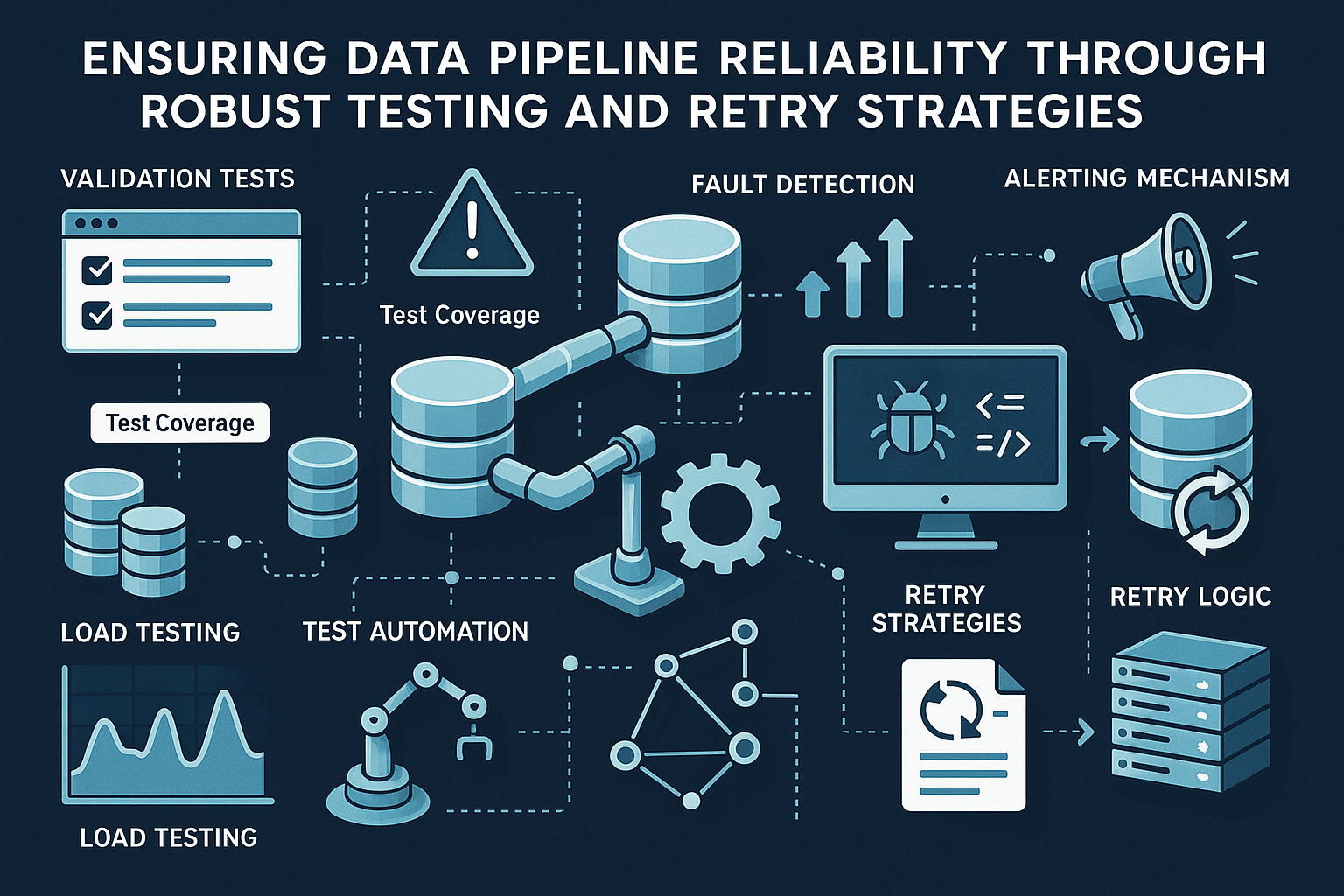
Introduction
Data pipelines form the backbone of data engineering workflows, enabling the extraction, transformation, and loading (ETL) of data for analytics, reporting, and machine learning. However, the complexity and scale of these pipelines introduce numerous points of failure. Ensuring pipeline reliability is essential to maintain data quality and trust in downstream systems.
This article focuses on two practical aspects of improving data pipeline reliability: rigorous testing methodologies and the implementation of retry patterns to handle transient errors.
The Challenge of Data Pipeline Reliability
Data pipelines often involve multiple components such as data ingestion, transformation jobs, storage systems, and orchestration tools. Failures can arise from network issues, API rate limits, resource constraints, or data anomalies. Without proper handling, these failures can cause data loss, duplication, or corruption.
Reliability is not just about preventing failures but also about detecting, recovering from, and minimizing the impact of failures when they occur.
Testing Data Pipelines: Key Practices
Testing data pipelines requires approaches beyond traditional software unit tests because pipelines process large volumes of data and integrate with external systems. Here are practical testing strategies:
1. Unit Testing Transformation Logic
- Isolate transformation functions and test them with representative input data.
- Validate that outputs meet expected schemas and business rules.
2. Integration Testing with Sample Data
- Run pipeline components end-to-end on small, controlled datasets.
- Verify that data flows correctly through each stage and that intermediate outputs are valid.
3. Data Quality Checks
- Implement automated checks for data completeness, consistency, and validity.
- Examples include null value detection, range checks, and referential integrity.
4. Schema Validation
- Use schema enforcement tools to detect unexpected changes in source or target data structures.
5. Performance and Load Testing
- Simulate production-scale data volumes to identify bottlenecks and resource constraints.
6. Monitoring and Alerting
- Continuously monitor pipeline health metrics and set alerts for anomalies.
Handling Failures with Retry Patterns
Failures in data pipelines are often transient, such as temporary network glitches or throttling by external APIs. Implementing retry logic can significantly improve pipeline resilience.
Understanding Retry Patterns
The Microsoft Azure Architecture Patterns documentation describes retry as a pattern that attempts an operation multiple times until it succeeds or a maximum retry count is reached. Key considerations include:
- Exponential Backoff: Increasing wait time between retries to reduce load and avoid repeated collisions.
- Jitter: Adding randomness to retry intervals to prevent synchronized retries across multiple clients.
- Idempotency: Ensuring that repeated operations do not cause unintended side effects.
Applying Retry Logic in Data Pipelines
- API Calls: When pipelines fetch data from APIs, implement retries with exponential backoff to handle rate limits or transient errors.
- Database Operations: Retrying transient database connection failures can prevent pipeline failures.
- Message Queues: When consuming messages, retries can handle temporary processing errors.
Practical Example
Suppose a pipeline step calls an external API to enrich data. If the API returns a 429 Too Many Requests error, the pipeline should:
- Detect the error.
- Wait for a backoff period (e.g., 1 second, then 2 seconds, then 4 seconds).
- Retry the request up to a configured limit.
- Log failures if retries are exhausted.
This approach reduces manual intervention and improves pipeline uptime.
Operationalizing Reliability Checks
Retry behavior should be paired with observable failure handling: record exhausted retries, alert operators, and keep retryable infrastructure failures distinct from deterministic data-quality or logic errors. GitHub Actions can be used to run automated tests on repository changes; its official documentation describes workflow automation and job execution (GitHub Actions documentation).
Limitations and Considerations
- Retries Are Not a Cure-All: Persistent errors due to data quality issues or logic bugs require root cause analysis and fixes.
- Idempotency Is Crucial: Without idempotent operations, retries can cause data duplication or corruption.
- Monitoring Is Essential: Retry mechanisms should be complemented with monitoring to detect patterns of failure.
- Testing Complexity: Testing retries and failure scenarios requires careful design of test cases and possibly mocking external dependencies.
Summary Checklist for Reliable Data Pipelines
- [ ] Implement unit and integration tests covering transformation logic and data flows.
- [ ] Enforce schema validation and data quality checks.
- [ ] Design pipeline steps to be idempotent where possible.
- [ ] Apply retry patterns with exponential backoff and jitter for transient failures.
- [ ] Use orchestration tools that support retries and alerting.
- [ ] Monitor pipeline health and set up alerts for failures.
- [ ] Analyze failure patterns and address root causes beyond transient errors.
Conclusion
Building reliable data pipelines requires a combination of thorough testing and robust error handling strategies. By implementing retry patterns thoughtfully and validating data at multiple stages, data engineers can reduce downtime and improve trust in their data systems. Leveraging orchestration tools with built-in retry and monitoring capabilities further enhances pipeline resilience.
For implementation guidance on transient-failure handling, see Microsoft's transient fault handling guidance. For repository-based test automation, see the GitHub Actions documentation.